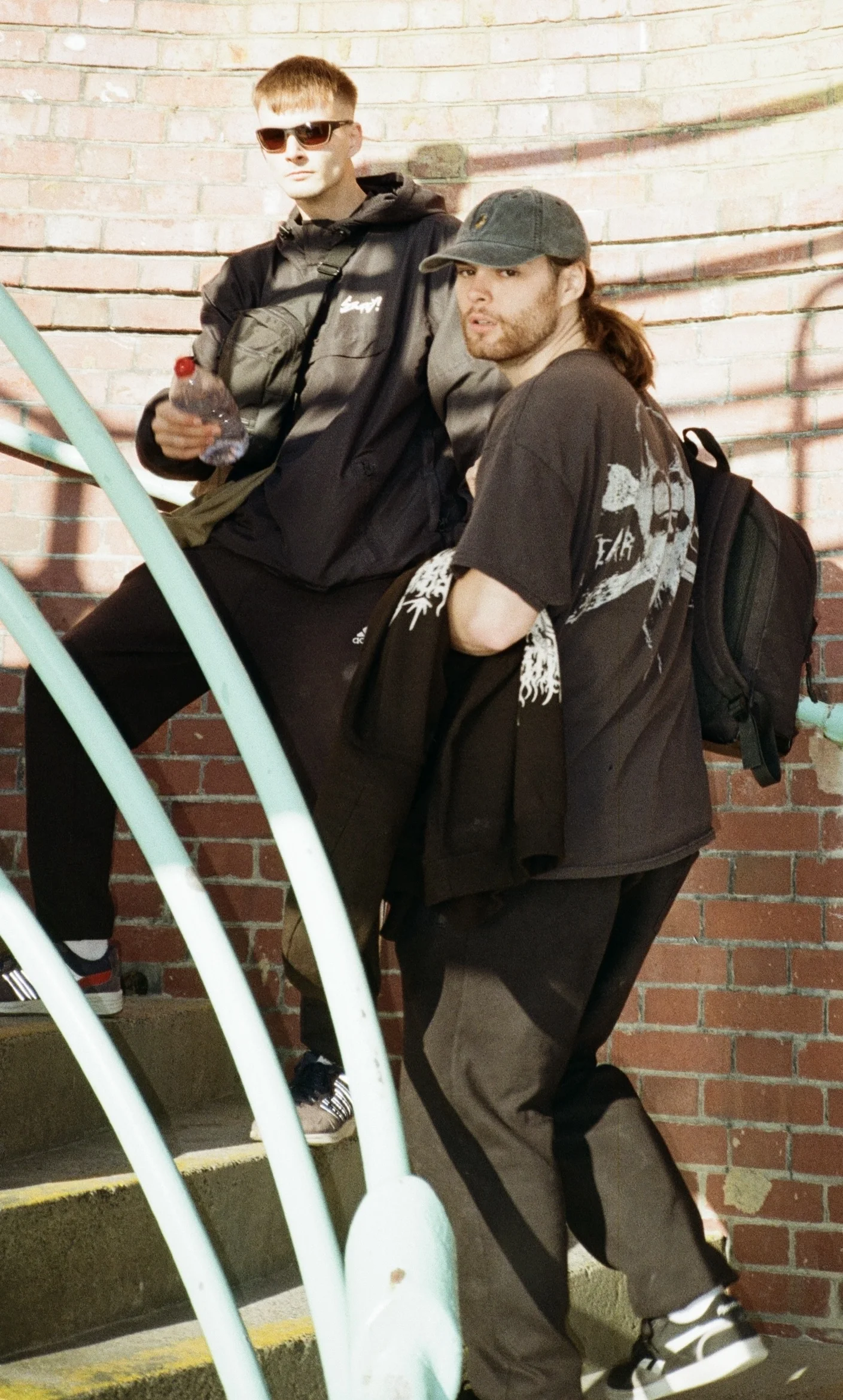
A Patch of Land and a Decision
There is a spot in South East London that does not appear on any official map. No signage, no council approval, no insurance. A group of young athletes decided that if no one was going to build them a training space, they would build one themselves. They call it Yard.
The Benk Boys started the same way most collectives do. A few friends who trained together, filmed each other, and started posting clips online. What sets them apart is not the content, though that has sharpened over the past year. What sets them apart is the infrastructure they are building around it. Not a Patreon. Not a brand deal. A spot. An actual physical place they made with their hands.
Yard is the centre of that infrastructure. A patch of unused land that the collective has gradually transformed into a functional training space. The first addition was a bench. Not a park bench. A homemade wooden bench, built from reclaimed materials, positioned at the exact height needed for a specific set of movements. Then came rails. Then walls. Then a growing rotation of obstacles that get modified, rebuilt, and reimagined as the collective's abilities evolve.
When I was coming up we built things too. Not parkour spots. Skate parks. That was the world we were in before parkour existed as anything. Same impulse though. You want to do something specific, the environment doesn't offer it, so you get together with your mates and make it.
What's different now is the sport itself. Back when we started there were fewer ways to move. Parkour was limited, still figuring out what it was, and the city itself was enough because the movements were basic enough to fit inside it. Now it's evolved into something where every collective has its own style, its own vocabulary, its own way of interpreting the environment. There are so many directions a single practitioner can go down that no public space, no commercial gym, no piece of found architecture can cover all of them at once. Which is why a spot like Yard stops being aesthetic and starts being necessary. You can't train something that doesn't have a surface for it to happen on. So you build the surface.
Operating Outside the Establishment
If you want to understand Benk, you need to understand their relationship with SupaXXL. The London-based collective has been one of the most consistent creative forces in UK parkour for years. Not the biggest. Not the loudest. The most consistent. For the Benk Boys, SupaXXL were not just influences. They were proof that you could operate outside the traditional parkour establishment and still build something that mattered. That's a lineage worth tracing.
The thing about watching this sport long enough is you start to see the cycles. Every few years the institutional side tries to absorb parkour. Competitions, federations, sanctioning bodies, all of it with good intentions. And every few years the ground-up side responds by pulling harder in the opposite direction. SupaXXL were part of that response ten years ago. Benk are part of it now.
That influence shows in the way Benk approach their content. There is an energy to it, a rawness, that does not try to compete with the polished productions of larger collectives. Instead it leans into authenticity. Phone footage mixed with proper camera work. Sessions that feel like sessions, not performances. The kind of content that makes you want to go outside and train, not just watch someone else do it.

We are not trying to be the next anyone. We are trying to be the first us.
Benk Boys
Everyone Who Visits Becomes Part of the Story
In late 2025, the Benk Boys hosted their first official jam. Not a competition. Not a showcase. A jam. The distinction matters. Jams are about community. About showing up, sharing lines, learning from each other, and leaving with more connections than you arrived with. There's no ranking at the end. No podium. You just train with people you don't normally train with and something small shifts in your understanding of what's possible.
The turnout exceeded expectations. Athletes from across London and beyond made the trip to Yard. For many, it was their first time seeing the spot in person. The reaction was consistent: surprise at what had been built, respect for the effort behind it, and an immediate understanding of why it mattered.
The jam itself ran all day. No schedule, no structure, just movement. The Benk Boys had set up a few new obstacles specifically for the event, and watching visiting athletes figure out the lines was one of the day's highlights. Different styles, different approaches, all converging on the same homemade infrastructure. That's the thing about spots you build yourself. Everyone who visits becomes part of the story of it.
There's a version of this story that frames Yard as DIY in the aesthetic sense. Exposed wood, patchwork rails, the look of a place that was built by hand. That's not what's interesting about it. What's interesting is that they built it because they needed it. Function, not aesthetic. Necessity, not nostalgia. And the people who turned up to the jam weren't there for the aesthetic either. They were there because something in the idea of Yard bypassed the usual gatekeeping and offered them something direct.

People turned up and could not believe we had built all of it ourselves. We are not waiting for permission. We are just building.
Benk Boys
The Jam Got the Edit It Deserved
The jam got the edit it deserved. Filmed and cut by @hector_the_director__, the Benk Jam video captures the energy and the atmosphere of the day in a way that photos alone cannot. This is what it looked and felt like to be there.
A Reason to Train Harder Next Week
The Benk Boys are not finished building. Yard continues to evolve. The collective continues to grow. And the first jam was explicitly described as the first, not the only. There is a long-term vision here that extends beyond content creation and into genuine community development. A spot that gets better every month. A jam that happens more than once. A collective that actively invites others in rather than circling the wagons around what they've made.
I keep coming back to that line. First us. It's such a small shift in phrasing but it changes everything. For years the pressure on every new crew has been to declare which crew they're the next version of. Who they're evolving from. Who they're quietly biting. Benk are refusing the premise entirely. They're not saying they're better than anyone. They're saying comparison isn't the point. And in a sport that measures everything, height, distance, consensus on what counts, that refusal to be measured against the previous generation is quietly radical.
I've been trying to work out why this story has stuck with me the way it has. Parkour has plenty of young collectives. Plenty of DIY spots. Plenty of jams. On paper there's nothing about Benk that you couldn't find somewhere else. And yet there's something about the combination. The clarity of the "first us" framing, the functional honesty of Yard, the refusal to treat any of it as a marketing exercise. That's what makes the whole thing land differently.
I think what I'm seeing is a generation that watched the institutional side of parkour spend the last ten years trying to legitimize the sport, and quietly decided that they weren't interested in that path. They're not mad at it. They're not writing manifestos against it. They're just doing something else. And the something else turns out to look a lot like what the sport looked like when it started. A spot. A group of friends. A session. A camera. A reason to train harder next week.
In a discipline that often celebrates the individual, Benk are a reminder that the most interesting things happen when a group of people commit to building something together. Not for views. Not for recognition. For the culture.
I'll be watching what they do next. If you know what's good for you, so will you.

Not for views. Not for recognition. For the culture.
Breach Culture
The story has been told. A collective in South East London decided they would build what they needed, because no one else was going to do it for them.
Words by Breach Culture. Film by @hector_the_director__. Featuring @benkboys.
Benk Jam
A day at Yard. DIY infrastructure, real community, and the kind of sessions you remember.