You Cannot Build a Culture on a Bus Timetable
When Luke first found parkour, he genuinely believed he was alone. Five people trained in Bedford at the time. They were older. Already on different paths. If you wanted to learn properly, you travelled. So he did. Every week to Milton Keynes to train with MKPK, now known as Paramount Parkour.
But you cannot build a culture on a bus timetable.
So he trained at school. On the sandpit. At lunch. After class. Anywhere. Friends started watching.
I've watched a lot of these stories over the years. Someone in a town that doesn't have a scene starts training alone, refuses to give up, eventually builds something that ends up feeding hundreds of kids into the sport. It's almost a genre at this point. But the stories tend to get told as inspirational underdog narratives, and I think that's a disservice to what's actually happening. These aren't feel-good stories. They're stories about what it costs to do this properly. Spiral is one of the clearest examples of that cost I've seen.
A Place Where You Learn to Stand Taller
He was not really coaching yet. Just passing on what he had learned. But that moment, without him knowing it, was the beginning.
Team Spiral was born out of necessity. Out of a lack of access. Out of a desire not to feel like the only person in your town jumping off walls. That feeling still drives everything they do.
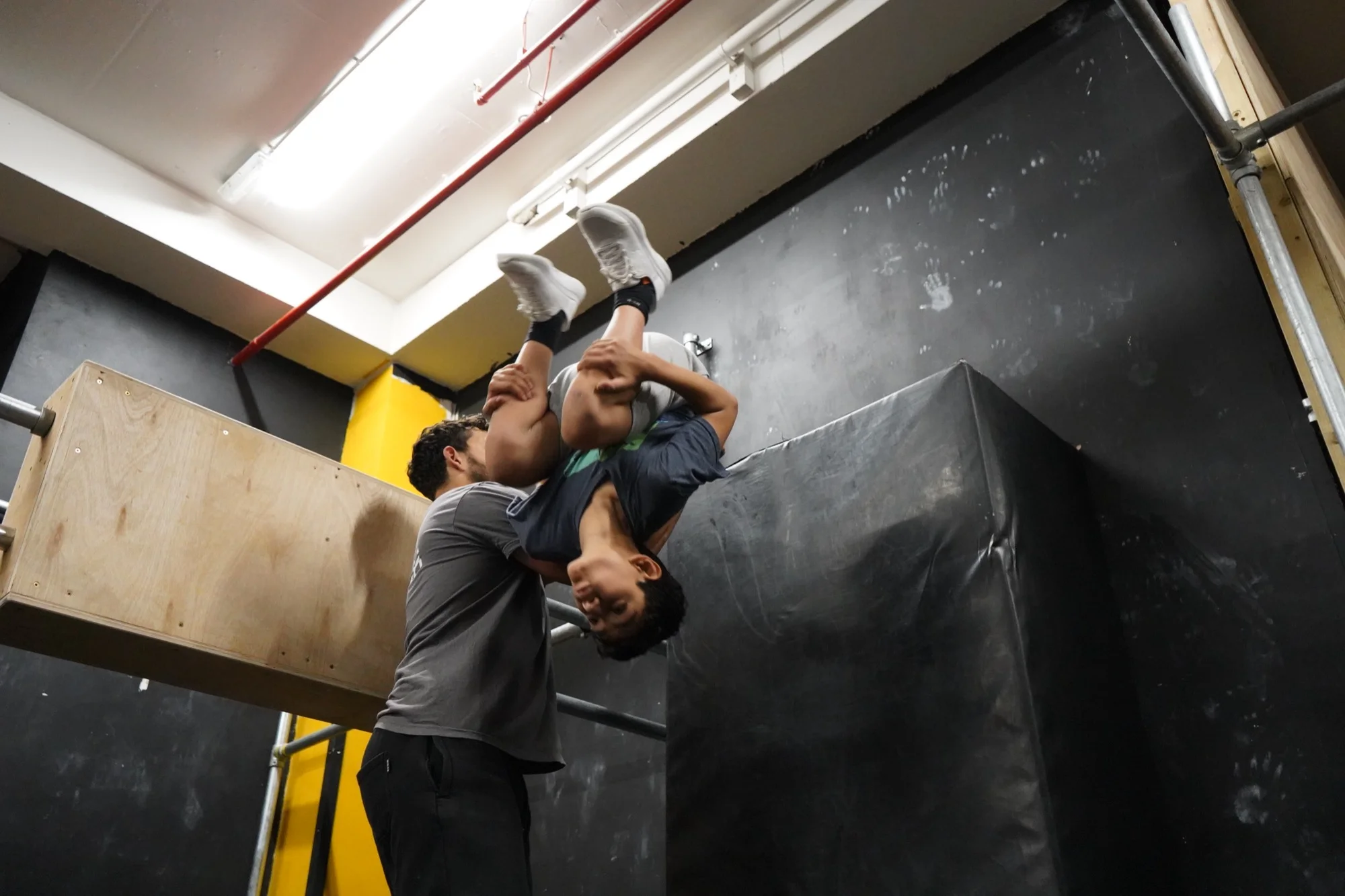
Spiral is now a Community Interest Company in the heart of Bedford. Tens of thousands of participants have come through their programmes since 2016. Regular classes. School outreach. Events. Mentorship.
But if you ask them what they really provide, it is not just parkour. It is belonging. A place where young people can walk in shy and unsure and, within weeks, start standing taller. Laughing louder. Trying things they never believed were possible.
Bedford does not have many spaces like that. Spiral became one. Not by accident. By intention.


"Teach us." And that was the beginning.
The moment that started everything
The Loop That Closes
Every community gym has a story that explains everything. For Spiral, one of those stories is Ryan.
He came through the doors during a difficult period in his life. Low confidence. Struggling at school. His parents hoped parkour might give him something positive.
It did more than that.
He found rhythm. He found progress. He found people who saw him.
Spiral didn't just coach him. They mentored him. He joined their mentorship pathway. Trained as a coach. Stayed.
Now he stands in front of the next generation with the same patience and energy that once helped him rebuild himself.
That is the loop. That is what this culture is supposed to do.
I talk about the loop a lot because I think it's the most honest measure of whether a community gym is doing its job. Coaching numbers, revenue, class sizes, all of that is noise. The real signal is whether a kid who walked in struggling eventually walks out capable of being the person who helps the next kid. That's a closed circuit that only works if the environment is actually functional, sustained, and patient. A lot of places try to build it. Most of them can't hold it together long enough for the loop to close. Spiral has, more than once, with more than one kid. That's the thing that makes them worth writing about.
Seven Months. No Wage.
Running a parkour facility in 2025 is not romantic.
Spiral operates inside a retail centre. The costs were far higher than expected. Utilities rising. Insurance rising. Maintenance constant.
At one stage, both directors went more than seven months without taking a wage.
Seven months.
Not because the gym was failing. But because the staff needed paying. Because the community needed continuity.
I want you to sit with that for a second. Seven months. Two adults running a legitimate business, managing a community facility, coaching sessions, handling paperwork, making decisions that affect hundreds of families, and taking home nothing. That's not an inspirational detail. That's an indictment. If this sport wants to keep producing the next generation of athletes, coaches, filmmakers, and community leaders, it cannot keep asking the people who run the infrastructure to subsidise it with their own wages. That model is not sustainable, and it is not fair, and I don't think we talk about it honestly enough.
Behind every class timetable is paperwork. Health and safety. Grant applications. Social media. Cleaning. Repairs. Emails. Funding bids. Conversations with worried parents.
There is always more to do. And still, they show up.

Seven months without a wage. Because the community needed continuity.
Spiral Freerun Directors
Not the Kind of Family You Are Born Into
Rising costs forced hard decisions. Reduced coaching hours. Directors stepping in to cover sessions. Leadership carrying admin, facility management and coaching simultaneously.
It is mentally heavy work.
But when you ask them what keeps them going, the answer is immediate.
Family.
Not the kind you are born into. The kind you build.
Spiral has run three successful crowdfunders over the years. When they needed help, the community did not just share posts. They donated. They backed the vision with real belief.
That tells you everything.

Connection Is the Real Currency
Memberships keep the lights on. Word of mouth brings new people through the doors. Grants and donations provide breathing room when things get tight.
But connection is the real currency.
Every recommendation. Every share. Every parent telling another parent. Every young person bringing a friend. That is how community gyms survive.
You do not have to live in Bedford to support Spiral.
Share their work. Connect them with collaborators. Introduce them to brands who understand culture. Donate if you can. Train there if you are local. Or simply tell someone that spaces like this matter.
Because they do. And because the cost of pretending they don't is paid, eventually, by the next kid who travels 25 miles just to find someone else who trains, and finds no one waiting.
Moved Spaces. Outgrown Venues. Rebuilt Every Time.
They started with a few hours in a local school. Now they run a full community facility in Bedford town centre.
They have moved spaces. Outgrown venues. Faced floods. Faced closures. Faced financial pressure that would have ended most independent facilities.
Each time, they adapted. Each time, they rebuilt. Not perfectly. Not easily. But together.
Raise the Standard. Build the Profession.
Spiral does not just want to survive. They want to raise the standard of parkour coaching in the UK.
To a level that matches mainstream sport. To a level where coaches can build careers. To a level where parkour is not treated as a side project but as a profession.
They want creativity. Film. Performance. Competition. Independent brands. Community projects. Cross collaboration.
They want parkour culture to grow wider without losing its roots. And they want Spiral to be part of that future.
Here's the part that makes this story matter beyond Spiral itself. When I started in this sport there was no such thing as a community gym. There was the street. There was your mate's garden. There was a patch of grass outside a school. The idea of a dedicated space where you could train properly, under coaching, with progressions, with mats, with other people who took the thing seriously, didn't exist. When that kind of space started to appear, it changed what was possible. Kids who would never have gone out onto a wall in winter could train indoors all year round. Parents who would never have sanctioned street training saw a structured class and said yes. The sport's population doubled, then doubled again, partly because community gyms existed to catch people who would otherwise have never found it.
Community gyms are the ladder. The street is the ground. The professional side is the roof. The ladder is the thing you climb. Without it, most people who love this sport never get to the roof, and the sport itself stops producing the next wave. That's why Spiral matters, and that's why it would be a genuine loss if places like it stopped being able to hold on.


Spiral exists because one kid was tired of feeling alone. Now thousands are not.
Breach Culture
The story is not finished. It keeps going every Tuesday evening when the next class starts, every time a new kid walks through the doors not knowing what they're about to find, and every time a former student shows up on the other side of the coaching relationship having made the loop close.
Words by Breach Culture. Featuring Spiral Freerun CIC · @spiralfreerun · @luke.spiral
Spiral Freerun
A community gym in Bedford that exists because it had to. Get involved.